 contact@dbuniversity.ac.in
  09476 690 950/ 08011 403 982
Test Program
Bachelor of Computer Applications
Duration: Four Years with Multiple Exit Options as per NEP Guidelines
No of Seats: 60
Bachelor of Computer Applications
The Bachelor of Computer Applications (BCA) programme is an AICTE-approved undergraduate degree structured in accordance with the National Education Policy (NEP) framework. Offered as a four-year programme with multiple exit options, it enables students to earn a Certificate after one year, a Diploma after two years, a Bachelor’s Degree after three years, and a Bachelor’s Degree with Honours or Honours with Research upon completion of four years. The programme is designed to provide a strong academic foundation in computing along with skill-oriented and multidisciplinary learning in line with NEP guidelines.
The curriculum emphasizes experiential and outcome-based learning through laboratory sessions, internships, service learning, mini projects, and major projects. Students can pursue specialization tracks in Web and Applications Development or Data Science, and those opting for the Honours with Research pathway undertake advanced study and dissertation work. The programme aims to develop technically competent, industry-ready, and socially responsible computing professionals prepared for careers, entrepreneurship, higher studies, and research.
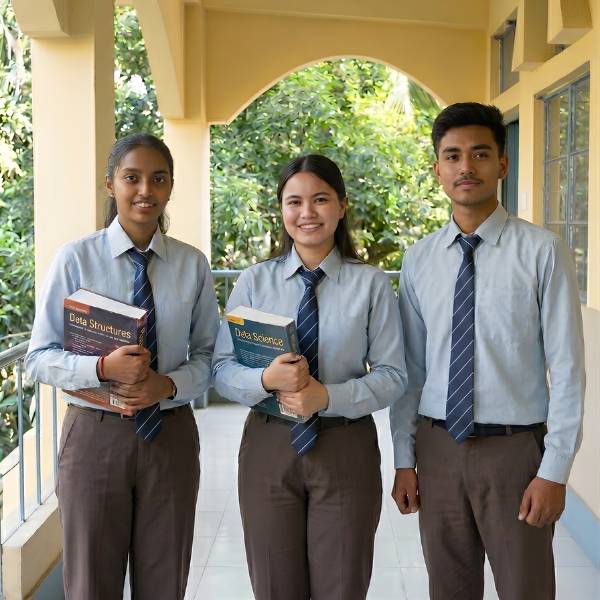
Program Highlights and Advantages
Empowering Future IT Leaders

Comprehensive Curriculum
Covers key areas like programming, networking, and software development.

Hands-On Training
Gain practical skills through industry projects and internships.

Cutting-Edge Tools
Access the latest software and technology for enhanced learning.

Industry Connections
Collaborate with top IT companies for real-world experience.
Program Overview & Structure
Three-Week Compulsory Induction Programme
Major Course 1 – Mathematical Foundation of Computer Science I
Major Course 2 – Computer Architecture
Major Course 2 – Computer Architecture Lab
Skill Enhancement Course 1 – Problem Solving Techniques
Skill Enhancement Course 1 – Problem Solving Techniques Lab
Multi-Disciplinary Elective 1 – Indian Knowledge System
Common Value Based Course 1 – Environmental Studies
Ability Enhancement Course 1 – General English – I
Ability Enhancement Course 2 – Communicative Hindi-I / Communicative Assamese-I / French Beginner Level I / Introduction to German Language – I
Major Course 3 – Mathematical Foundation of Computer Science II
Major Course 4 – Data Structures
Major Course 4 – Data Structures Lab
Major Course 5 – Operating Systems
Major Course 5 – Operating Systems Lab
Skill Enhancement Course 2 – Object-Oriented Programming using Java
Skill Enhancement Course 2 – Object-Oriented Programming using Java Lab
Skill Enhancement Course 3 – Web Technologies
Skill Enhancement Course 3 – Web Technologies Lab
Common Value Based Course 2 – Understanding India
Ability Enhancement Course 3 – Communicative Hindi-II / Communicative Assamese-II / French Beginner Level II / Introduction to German Language – II
Major Course 6 – Probability and Statistics
Major Course 7 – Database Management System
Major Course 7 – Database Management System Lab
Major Course 8 – Software Engineering
Skill Enhancement Course 4 – Python Programming
Skill Enhancement Course 4 – Python Programming Lab
Common Value Based Course 3 – Health and Wellness, Yoga Education, and Sports and Fitness
Community Engagement Course 1 – Service Learning Theory
Specialization – Web and Applications Development
Discipline Specific Elective 1 – UI/UX Designing and Prototyping
Discipline Specific Elective 1 – UI/UX Designing and Prototyping Lab
Specialization – Data Science
Discipline Specific Elective 1 – Basics of Data Analytics Using Spreadsheet
Discipline Specific Elective 1 – Basics of Data Analytics Using Spreadsheet Lab
Major Course 9 – Entrepreneurship and Startup Ecosystem
Major Course 10 – Computer Networks
Major Course 10 – Computer Networks Lab
Major Course 11 – Design and Analysis of Algorithm
Major Course 12 – Introduction to Artificial Intelligence
Major Course 12 – Introduction to Artificial Intelligence Lab
Skill Enhancement Course 5 – Design Thinking and Innovation
Community Engagement Course 2 – Service-Learning Practice
Specialization – Web and Applications Development
Discipline Specific Elective 2 – Web Programming using PHP and Laravel Framework
Discipline Specific Elective 2 – Web Programming using PHP and Laravel Framework Lab
Specialization – Data Science
Discipline Specific Elective 2 – Data Visualization
Discipline Specific Elective 2 – Data Visualization Lab
Major Course 13 – Quantitative Techniques
Internship – Industry Internship
Project – Mini Project
Specialization – Web and Applications Development
Discipline Specific Elective 3 – ReactJS Fundamentals
Discipline Specific Elective 3 – ReactJS Fundamentals Lab
Discipline Specific Elective 4 – API Integration and Development
Discipline Specific Elective 4 – API Integration and Development Lab
Discipline Specific Elective 5 – Introduction to NoSQL
Discipline Specific Elective 5 – Introduction to NoSQL Lab
Specialization – Data Science
Discipline Specific Elective 3 – Introduction to Data Science
Discipline Specific Elective 3 – Introduction to Data Science Lab
Discipline Specific Elective 4 – Machine Learning
Discipline Specific Elective 4 – Machine Learning Lab
Discipline Specific Elective 5 – Time Series Analysis
Discipline Specific Elective 5 – Time Series Analysis Lab
Major Course 14 – Generative AI
Major Course 14 – Generative AI Lab
Ability Enhancement Course – Soft Skills
Project – Minor Project
Specialization – Web and Applications Development
Discipline Specific Elective 6 – Back-End Development using Node.js and Express.js
Discipline Specific Elective 6 – Back-End Development using Node.js and Express.js Lab
Discipline Specific Elective 7 – Introduction to DevOps
Discipline Specific Elective 7 – Introduction to DevOps Lab
Specialization – Data Science
Discipline Specific Elective 6 – Exploratory Data Analysis
Discipline Specific Elective 6 – Exploratory Data Analysis Lab
Discipline Specific Elective 7 – Big Data Analytics
Discipline Specific Elective 7 – Big Data Analytics Lab
Specialization – Web and Applications Development
Major Course 15 – Python for Web Programming
Major Course 15 – Python for Web Programming Lab
Multi-Disciplinary Elective 2 – E-Commerce and Digital Marketing
Discipline Specific Elective 8 – Mobile Application Development
Discipline Specific Elective 8 – Mobile Application Development Lab
Discipline Specific Elective 9 – IoT and Web Connectivity
Major Project – Major Project – Part I
Specialization – Data Science
Major Course 15 – Python for Data Science
Major Course 15 – Python for Data Science Lab
Multi-Disciplinary Elective 2 – Advanced Statistical Methods for Data Science
Discipline Specific Elective 8 – Business Intelligence and Analytics
Discipline Specific Elective 8 – Business Intelligence and Analytics Lab
Discipline Specific Elective 9 – Data Warehousing and Data Mining
Dissertation – Dissertation – Part I
Specialization – Data Science
Major Course 15 – Advanced Data Analysis Tools
Major Course 16 – Research Methodology
Major Course 17 – Research Internship
Discipline Specific Elective 8 – Business Intelligence and Analytics
Discipline Specific Elective 8 – Business Intelligence and Analytics Lab
Discipline Specific Elective 9 – Data Warehousing and Data Mining
Specialization – Web and Applications Development
Discipline Specific Elective 10 – Web Application Security
Discipline Specific Elective 10 – Web Application Security Lab
Discipline Specific Elective 11 – Blockchain for Web Application
Discipline Specific Elective 11 – Blockchain for Web Application Lab
Discipline Specific Elective 12 – Cloud Computing
Major Project – Major Project – Part II
Specialization – Data Science
Discipline Specific Elective 10 – Advanced Data Visualization
Discipline Specific Elective 10 – Advanced Data Visualization Lab
Discipline Specific Elective 11 – Cloud Computing for Data Analytics
Discipline Specific Elective 11 – Cloud Computing for Data Analytics Lab
Discipline Specific Elective 12 – Data Security and Privacy
Dissertation – Dissertation – Part II
Specialization – Data Science
Dissertation – Dissertation
Degree offered by us
Eligibility
Grade /Marks requirement from qualifying examinations
Passed Higher Secondary School Leaving Examination (or equivalent) in any stream with 50% in the aggregate. Those who have pursued Mathematics at Class XII will have an advantage.
Entrance Examinations / Personal Interview
Candidates must appear for a personal interview
Salient Features of the BCA Programme
AICTE-Approved Programme
aligned with National Education Policy (NEP) guidelines
Four-Year Structure with Multiple Exit Options
(Certificate, Diploma, Degree, Honours, Honours with Research)
Contemporary and Industry-Aligned Curriculum
covering emerging technologies
Choice-Based Specializations
in Web & Applications Development and Data Science
Industry Visits
for real-world exposure
Industry-Based Internship
for hands-on professional experience
Project-Based and Experiential Learning
(Mini Project, Major Project, Research Dissertation)
Strong Laboratory Component
with practical-intensive courses
Focus on Emerging Areas
such as Artificial Intelligence, Generative AI, Cloud Computing, DevOps, Blockchain, and Big Data
Entrepreneurship and Innovation Orientation
through Design Thinking and Startup Ecosystem courses
Community Engagement and Service Learning
for social responsibility
Soft Skills and Communication Training
for holistic personality development
Research Pathway
(Honours with Research Option) for higher studies and Ph.D. readiness
Career Preparation Support
for placements, higher education, and competitive exams
F.A.Q.
The university offers a range of undergraduate, graduate, and doctoral programs across disciplines including engineering, science, arts, business, and health sciences. Each program has its own specific requirements and areas of focus.
You can apply online through our university’s admissions portal. Complete the application form, submit the required documents (such as transcripts, test scores, and recommendation letters), and pay the application fee. Detailed instructions are available on our admissions webpage.
Admission requirements vary by program. Typically, undergraduate programs require a high school diploma and specific academic credentials, while graduate programs may require a bachelor’s degree in a related field, relevant test scores, and work experience. Be sure to review the specific requirements for the program to which you are applying.
Yes, the university offers a variety of scholarships and financial aid programs based on academic merit, financial need, and other criteria. Information about available scholarships and how to apply is available on the university’s financial aid webpage.
Application deadlines vary depending on the program and the intake period (e.g., fall, spring). Be sure to check the program’s admissions page for specific deadlines.