contact@dbuniversity.ac.in
 09476 690 950/ 08011 403 982

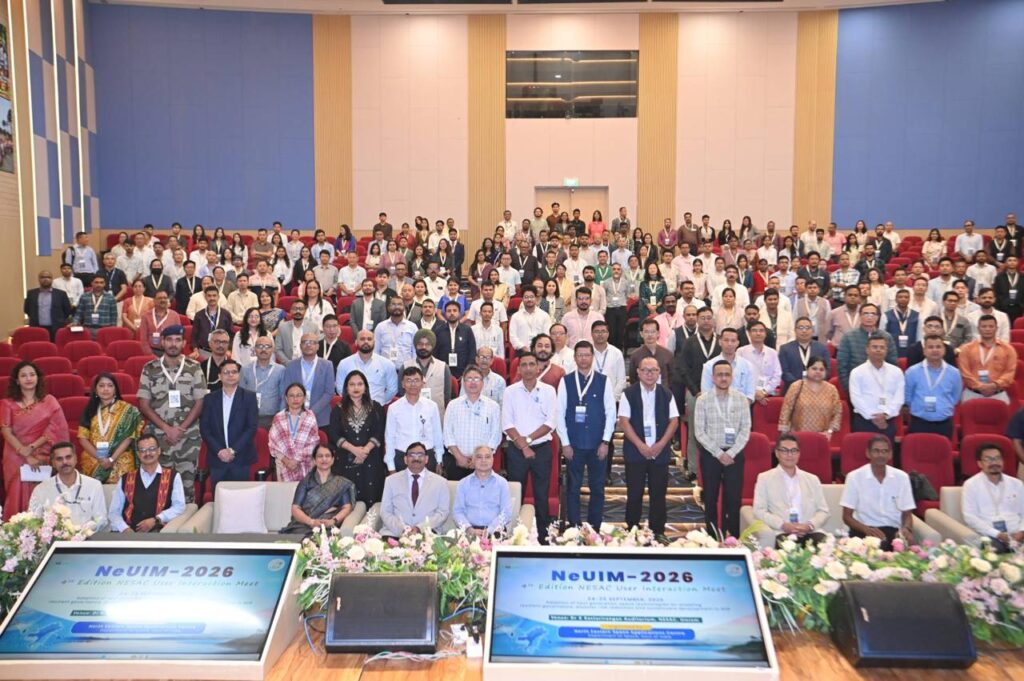
The 4th NESAC User Interaction Meet (NeUIM-2026), organised by the North Eastern Space Applications Centre (NESAC), Department of Space, Government of India, was held on 24–25 September 2026 at the Dr. K. Kasturirangan Auditorium, NESAC, Umiam, Meghalaya. I had the opportunity to participate in this important biennial gathering, which brought together representatives from government departments, state remote sensing agencies, academic and research institutions, startups and students from across the eight states of Northeast India to deliberate on the growing role of space and geospatial technologies in governance, disaster risk reduction and sustainable development. The 2026 edition was particularly significant as it coincided with the 25th year of NESAC, with 75 academic experts representing 52 universities participating in the programme. The inaugural session featured addresses by Dr. S. P. Aggarwal, Director, NESAC; Shri P. L. N. Raju, Special Secretary, STCCD and Director, ASSAC; Shri M. Ganesh Pillai, Scientific Secretary, ISRO; and Chief Guest Shri Satinder Kumar Bhalla, Secretary, North Eastern Council, who highlighted the importance of making space technology increasingly accessible, relevant and responsive to the practical needs of communities in the region. Over the two days, a series of technical sessions explored developments in Earth Observation, remote sensing, GIS, artificial intelligence, satellite communication, disaster management, environmental monitoring, resilient governance and next-generation geospatial technologies. Representatives from different North Eastern states also shared their experiences, achievements and challenges in applying remote sensing and geospatial tools to regional development. Special emphasis was placed on applications in areas such as flood and landslide management, public health, water-resource planning, environmental monitoring, early-warning systems, urban and rural planning and higher education. The programme further highlighted the growing role of industry and startups, with innovations involving AI, drones, satellite-based connectivity, precision agriculture, healthcare applications, digital twins and infrastructure planning. Participation in NeUIM-2026 was an enriching experience that provided valuable insights into the evolving landscape of space and geospatial technologies in India and their growing relevance to academic teaching, research and student projects. The interactions and technical deliberations also opened up possibilities for closer engagement with NESAC in areas such as land-use mapping, flood modelling, environmental monitoring and other geospatial applications, offering meaningful opportunities for interdisciplinary research, collaboration and capacity building at Assam Don Bosco University.
By Dr. Jeni Bhattacharjee, Assistant Professor, Department of Civil Engineering, Assam Don Bosco University