 contact@dbuniversity.ac.in
  09476 690 950/ 08011 403 982
Arbanylla War
4th Semester, MSc Biotechnology
Department of Bio-Sciences, Assam Don Bosco University
warbanylla@gmail.com
Imagine if we could edit the genetic code of living organisms as easily as correcting a spelling mistake or typo in a sentence. What if genetic diseases could be eliminated before birth, or crops could be engineered to withstand extreme harsh climates? These possibilities are no longer hypothetical, all thanks to CRISPR-Cas 9.
CRISPR-Cas9 is a groundbreaking gene-editing tool that allows precise changes to be made to DNA in almost any cell or organism. Its name stands for ‘Clustered Regularly Interspaced Short Palindromic Repeats’ (CRISPR) and ‘CRISPR-associated protein 9’ (Cas9). Originally discovered as an immune defence in bacteria, helping them remember and destroy viruses that try to attack them. After this discovery, scientists then figured out how to use it as a powerful tool in biology.
Its development earned Jennifer Doudna and Emmanuelle Charpentier the 2020 Nobel Prize in Chemistry, marking a pivotal moment in the history of biotechnology.
But how does it work?
If DNA were a WhatsApp message, mutations would be those embarrassing autocorrect errors that completely change the meaning. Genome editing is like going back, editing the message, and finally sending what you actually meant in the first place. The goal of genome editing is to fix the DNA, enabling the production of missing proteins (the tiny workers that build, repair, and run almost everything in your body) or reducing the production of toxic ones
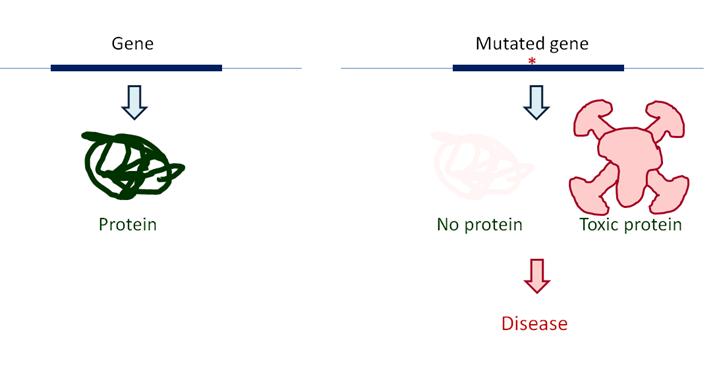
Figure: Genes encode proteins. When genes are mutated, this results in disease due to a lack of proteins or the formation of toxic proteins.
(https://www.exonskipping.nl/whats-hot/blog-crispr-technology/)
Genome editing uses the cell’s DNA repair mechanisms, which are activated by DNA damage. This is where CRISPR comes in. The system consists of two key components: a guide RNA, which identifies the target DNA sequence (acting as a GPS) and the Cas9 enzyme which works as molecular scissors, cutting the DNA at that precise location. These components are used to identify the sequence of the human genome that’s causing a health problem, and then they cut the DNA at that point. Scientists can then edit the existing genome by either modifying, deleting, or inserting new sequences, which effectively makes CRISPR Cas9 a cut-and-paste tool for DNA editing.
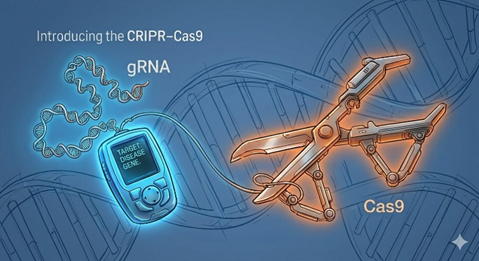
Figure: The two components of CRISPR-Cas9: gRNA and Cas9 (image is AI-generated)
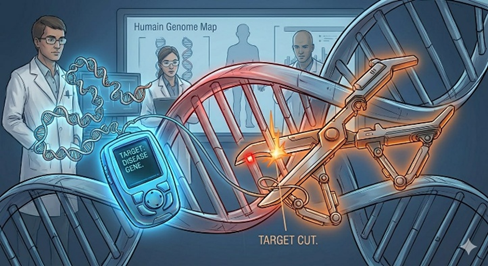
Figure: The gRNA directs the Cas9 to create a precise cut in the DNA double helix (image is AI-generated)
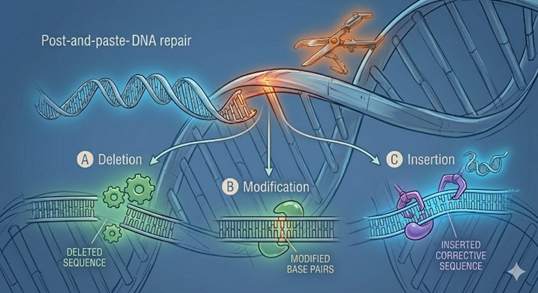
Figure: A diagram illustrating the potential “cut and paste” DNA repair mechanism after a CRISPR cut: Deletion, Modification, and Insertion. (image is AI-generated)
Why is everyone so excited about it?
The main reason is its potential in medicine. CRISPR-Cas9 is one of those science breakthroughs that feels almost futuristic; it allows targeted changes to DNA (which was once thought to be untouchable), raising the exciting possibility of treating or even curing genetic diseases. Researchers are already exploring big areas like infectious diseases (including HIV) and cancer, where engineered immune cells and T-cells can be modified to fight tumours.
But with great power comes great responsibility
One major concern is off-target edits, where this system can cut DNA in the “wrong” place, which could lead to harmful effects or ethical concerns, as the idea of editing human embryos raises difficult questions: Are we playing God? Leading to controversial concepts of “designer babies”. The good news is that scientists are constantly working to make CRISPR-Cas9 more precise and safer.
In short, CRISPR is already moving from theory to real-world treatments, and these early successes are just the beginning!