 contact@dbuniversity.ac.in
  09476 690 950/ 08011 403 982
Cherylene P. Sohtun
4th Semester, MSc. Microbiology
Department of Bio-Sciences, Assam Don Bosco University.
Email: cherylenesohtun@gmail.com
Ever wondered how some folks weathered the pandemic without ever catching COVID-19, even when their whole family was down with the count? It wasn’t always sheer luck. Turns out, there might be something hiding right inside their noses: a community of bacteria living there; Microbiologists call it ‘The Nasal Microbiome.’
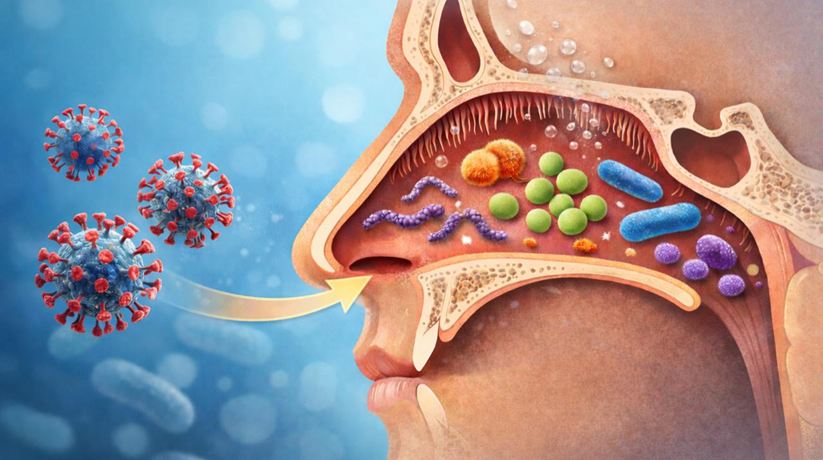
Fig: SARS-CoV-2 entry within the nasal microbiota. (Image is AI-generated)
New research shows it can quietly dial up or dial down your risk of catching the virus. Pretty wild, right?
Let me elaborate, your nose is the virus’s most favoured doorway. SARS-CoV-2 latches onto proteins called ACE2 receptors on the cells lining your nasal passages. Then an enzyme named TMPRSS2 helps the virus enter and start replicating. This is almost like a welcome mat and key for the virus. Higher levels of ACE2 and TMPRSS2 mean an easier entry ticket, but here’s where the microbiome steps in – the good and friendly bacteria tweak how much of those proteins your body makes.
A 2025 study from George Washington University tracked over 1500 adults before and after possible exposure. They found that people having higher levels of ACE2 and TMPRSS2 were 3.6 times more likely to get infected. The plot twist? Their nose microbiome might have played a role. An abundance of Dolosigranulum pigrum, ‘the friendly bug,’kept those entry proteins low. Think of it as a bouncer slamming the door on the intruders- in this context, the virus. People packed with this bacterium stayed healthy even when exposed. For more info, go to : https://www.thelancet.com/journals/ebiom/article/PIIS2352-3964(25)00104-5/fulltext
Not every bacteria is your friend though. Staphylococcus aureus, Moraxella catarrhalis and Haemophillus influenzae in great numbers exacerbate the infection by pushing ACE2 and TMPRSS2 expression. These microbes were rolling out the red carpet for SARS-CoV-2. Read more : https://publichealth.gwu.edu/certain-nasal-bacteria-may-boost-risk-covid-19-infection-study-finds
Results from another study in 2023 on Corynebacterium strains (especially C. accolens ) are living in your nose and act as gatekeepers. They reduce the entry helpers ACE2, TMPRSS2 and even another entry helper called cathepsin L. Certain strains produce enzymes that break down the virus’s lipid envelope. Together with D. pigrum, they create a protective barrier shielding you from the virus. Read more: https://pubmed.ncbi.nlm.nih.gov/37338780/
Of course, your nose bacteria aren’t the whole story. Genetics, exposure levels and quick immune responses matter too. This research however, opens doors to simple ideas like nasal probiotic sprays someday. It’s a reminder that we’re not just hosts, we’re walking ecosystems.
As for me, I thought I’d dodged COVID through the worst waves while living in a busy household and had parents travelling for work. I always joked it was just ‘good genes,’ then I actually caught it while I was on antibiotics for Tuberculosis. After reading about the normal microbiome I started to wonder if the antibiotics had wiped out the helpful bacteria like D. pigrum and Corynebacterium that had been keeping ACE2 and TMPRSS2 on low levels. Who knew those invisible nose bacteria were the real MVPs all along?