contact@dbuniversity.ac.in
  09476 690 950/ 08011 403 982
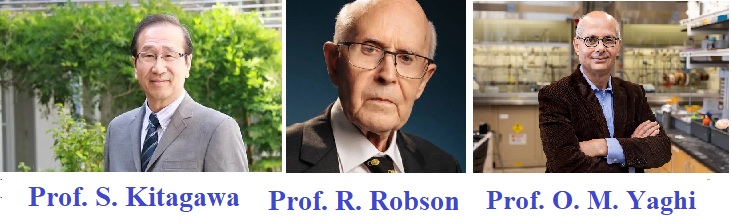
The Nobel Prize in Chemistry 2025 was jointly awarded to three renowned scientists—Professor Susumu Kitagawa, Professor Richard Robson, and Professor Omar M. Yaghi—for their revolutionary work in the development of metal–organic frameworks (MOFs). MOFs are highly porous crystalline materials formed by linking metal ions with organic molecules. These structures possess extremely large internal surface areas and tunable properties. These materials can store, trap, and separate gases. Some important practical applications of MOFs include carbon capture and climate change mitigation, water purification, pollutant removal, hydrogen storage for clean energy solutions, catalysis, sensing, and harvesting drinking water from air in desert. Thus, MOFs have a huge impact on present science and society. The research work of these scientists has revolutionized materials chemistry to design innovative devices that can be employed to solve many real-life problems. MOFs are recently considered one of the most promising materials of the 21st century due to their potential applications in minimizing environmental pollution and achieving sustainable development.
Prof. Susumu Kitagawa Research area: Coordination chemistry, organic–inorganic hybrid materials, and porous coordination polymers (MOFs). He is especially known for demonstrating gas adsorption and functional properties of porous coordination polymers (early MOFs)
Prof. Richard Robson Research area: Coordination polymers, crystal engineering using transition metals, and early design of MOF-like architectures. He is considered a pioneer who initiated the structural design concept (1989), rather than working on “modern MOFs” in the same way as Yaghi
Professor Omar M. Yaghi Research area: Metal–organic frameworks (MOFs) and reticular chemistry (field founder). He formalized and named “reticular chemistry”, which is the design principle behind MOFs… By Dr Subhasish Roy