contact@dbuniversity.ac.in
  09476 690 950/ 08011 403 982
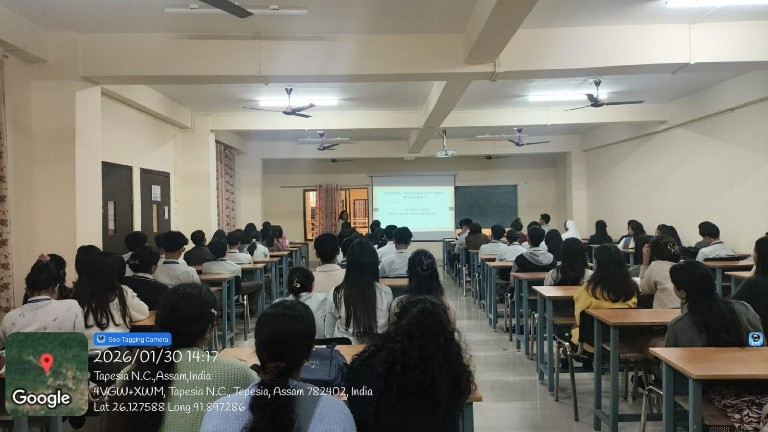
The Institute of Pharmacy at Assam Don Bosco University observed World Leprosy Day with an awareness programme to educate students on the medical, social, and ethical dimensions of leprosy management. In India, World Leprosy Day is observed on January 30, 2026 from 02:00 PM to 3:20 PM to coincide with the martyrdom of Mahatma Gandhi, who strongly advocated for the dignity and care of persons affected by the disease.
The programme began with an orientation session highlighting the core principles of leprosy awareness. Speakers emphasised that leprosy is not a curse or a consequence of past sins, but a chronic infectious disease caused by Mycobacterium leprae. Students were sensitised to the importance of the “golden window” of early detection — stressing that timely diagnosis before nerve damage can prevent permanent disability and social ostracisation.
As pharmacy students, participants were reminded of their professional responsibility in supporting the Multi-Drug Therapy (MDT) regimen, which includes Rifampicin, Dapsone, and Clofazimine. Ensuring patient adherence to the full course of treatment was highlighted as essential to prevent drug resistance and achieve complete cure. The keynote address was delivered by Dr. Tiewlasubon Uriah, a respected medical professional with extensive experience in managing leprosy cases in Northeast India. Bridging textbook pharmacology with real-world patient care, Dr. Uriah provided a comprehensive overview of the clinical and social aspects of the disease.
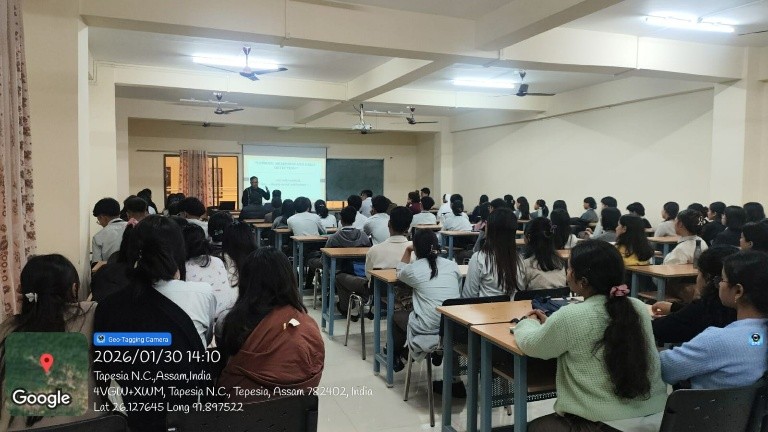
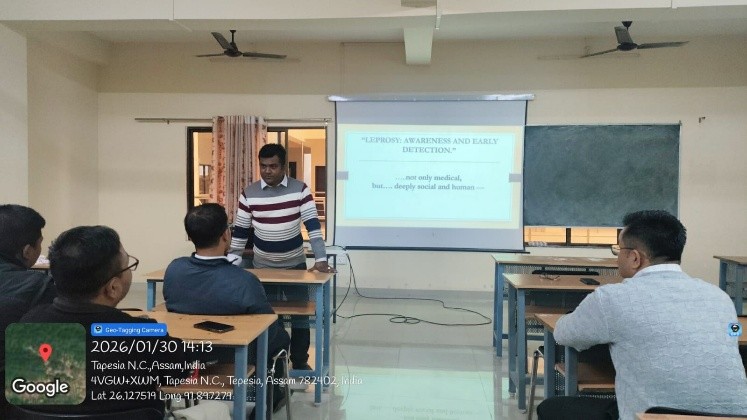
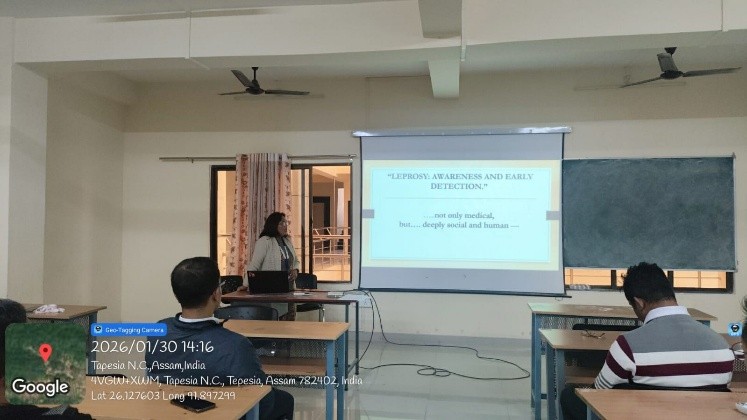
Explaining the clinical identification and pathophysiology of leprosy, Dr. Uriah noted that the disease primarily affects the peripheral nerves, skin, upper respiratory tract, and eyes. She outlined the cardinal diagnostic sign — a hypopigmented skin patch with definite loss of sensation. Students were also briefed on nerve function assessment, including identification of thickened nerves such as the ulnar and peroneal nerves, which can result in deformities like claw hand or foot drop if untreated.
Addressing pharmacological management, Dr. Uriah detailed the structured MDT blister pack system: six months of treatment for Paucibacillary (PB) cases and twelve months for Multibacillary (MB) cases. She also discussed the management of “Lepra reactions,” sudden inflammatory episodes that may require corticosteroids such as Prednisolone to prevent further nerve damage.
Beyond medical treatment, Dr. Uriah underscored the challenge of social stigma, remarking that “stigma is often harder to cure than the disease.” She emphasized patient self-care practices, including protecting insensitive limbs with oil application and appropriate footwear to prevent injuries. Students were encouraged to act as community ambassadors, spreading awareness that leprosy is not highly infectious and that patients become non-contagious within days of starting MDT.
The programme concluded with an interactive session, during which students raised practical concerns about patient compliance. In response to a question on handling treatment discontinuation, Dr. Uriah stressed the importance of Directly Observed Treatment (DOTS) and the critical role pharmacists play in providing counseling and psychological support to ensure completion of the six- to twelve-month therapy.
The event reaffirmed the university community’s commitment toward contributing to a “Leprosy-Free India,” equipping future pharmacists with both clinical competence and social responsibility.