contact@dbuniversity.ac.in
  09476 690 950/ 08011 403 982
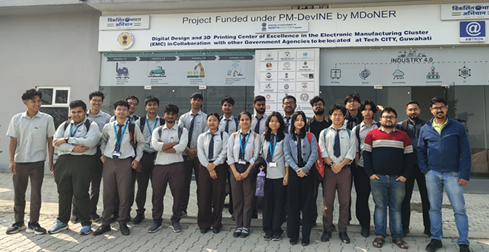
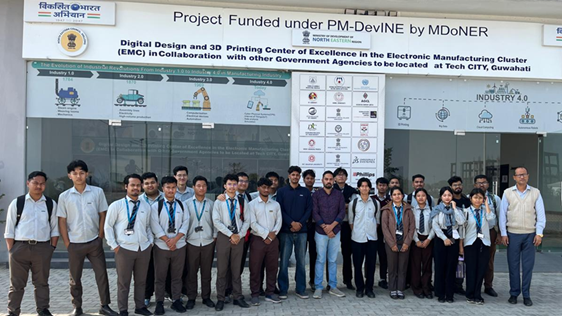
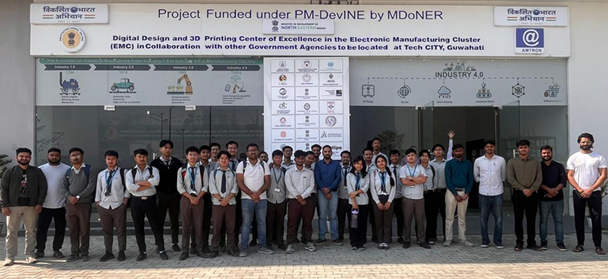
A group of 36 students from the Department of Mechanical Engineering successfully completed a four-day Industrial Visit and Short-Term Course on “Digital Design and 3D Printing” at the AMTRON 3D Printing Centre of Excellence in Guwahati, from 16/02/2026 to 19/02/2026. The program was meticulously designed to provide the students with a comprehensive understanding of additive manufacturing technologies, bridging the gap between theoretical knowledge and industrial application. The department faculty played a crucial role in facilitating this learning experience by accompanying the students each day.
The first day of the program was focused on establishing the core principles of digital design and the most accessible form of 3D printing, Fused Deposition Modeling (FDM). The students were accompanied by faculty members Mr. Harajit Das and Mr. Tapash Jyoti Kalita. The sessions were led by the expert trainers at the AMTRON Centre of Excellence, who began by introducing the participants to the fundamental concepts of additive manufacturing, its historical evolution, and its transformative potential across various industries. The primary focus, however, was on hands-on learning. The students were guided through the process of 3D modelling using professional design software. They learnt the intricacies of creating digital 3D models, from basic sketches to complex geometries, understanding the design constraints and allowances required for successful printing. Following the design phase, the focus shifted to the FDM process itself. The trainers provided a detailed demonstration of machine setup, including bed levelling, filament loading, and slicing software configuration.
Building on the foundational knowledge of Day 1, the second day delved into the specialized application of Direct Metal Laser Sintering (DMLS). The students were accompanied by faculty members Mr. Pallav Gogoi and Dr. Dhrubajit Sarma. This session moved beyond polymers to explore the world of metal additive manufacturing. The experts at the Centre of Excellence provided a comprehensive overview of the DMLS process, explaining how a high-powered laser selectively fuses fine metal powder particles to create dense, functional metal parts directly from a 3D CAD model. The students learnt about the various metal alloys that can be processed, such as titanium, stainless steel, and aluminium, and their specific applications based on mechanical properties. Observing the machine in operation, the students gained a profound appreciation for the complexity and capability of this technology to produce parts with geometries impossible to achieve through conventional subtractive manufacturing.
The third day elevated the students’ understanding to the specialized application of 3D printing in the medical and dental fields. Dr. Buljit Buragohain and Mr. Pranjal Sarma accompanied the students on this day. The sessions were dedicated to demonstrating how additive manufacturing is revolutionizing dental practices through high-precision, customized solutions. The AMTRON experts illustrated the shift from traditional, labour-intensive methods to digital workflows in dentistry. The students were shown how intraoral scanners are used to capture precise digital impressions, eliminating the discomfort of conventional moulds. They then learnt how this digital data is processed using specialized dental design software to create models for crowns, bridges, aligners, and surgical guides. The highlight of the day was the live demonstration of printing these intricate dental models using high-resolution 3D printers. The participants observed the printing of biocompatible resins, understanding the parameters that influence the accuracy, surface finish, and strength of the final product. This session was particularly impactful as it showcased the direct, life-changing applications of engineering principles in healthcare.
The final day of the course provided a holistic view of the product development cycle by introducing 3D scanning alongside advanced biomedical printing. The students were accompanied by Dr. Dhrubajit Sarma. The day commenced with a session on 3D scanning, a key technology for reverse engineering. The students learnt how laser and structured light scanners capture the physical dimensions of an existing object to generate a precise digital point cloud, which is then converted into a usable 3D model. They had the opportunity to scan various objects and components, understanding the challenges and best practices for achieving accurate scans. This digital data was then shown to be used for analysis, inspection, or as a base for redesign, demonstrating a complete closed-loop process from physical object to digital model and back to a printed part. The latter half of the day was dedicated to exploring the frontiers of biomedical 3D printing. The experts showcased specialized bioprinters and the research being conducted in printing scaffolds for tissue engineering and patient-specific anatomical models for pre-surgical planning. The session underscored the immense potential of additive manufacturing to not only create tools and machines but also to interface with biology to improve human health. The day concluded with a valedictory function where all 36 participating students were awarded certificates for their successful completion of the four-day program.