contact@dbuniversity.ac.in
  09476 690 950/ 08011 403 982
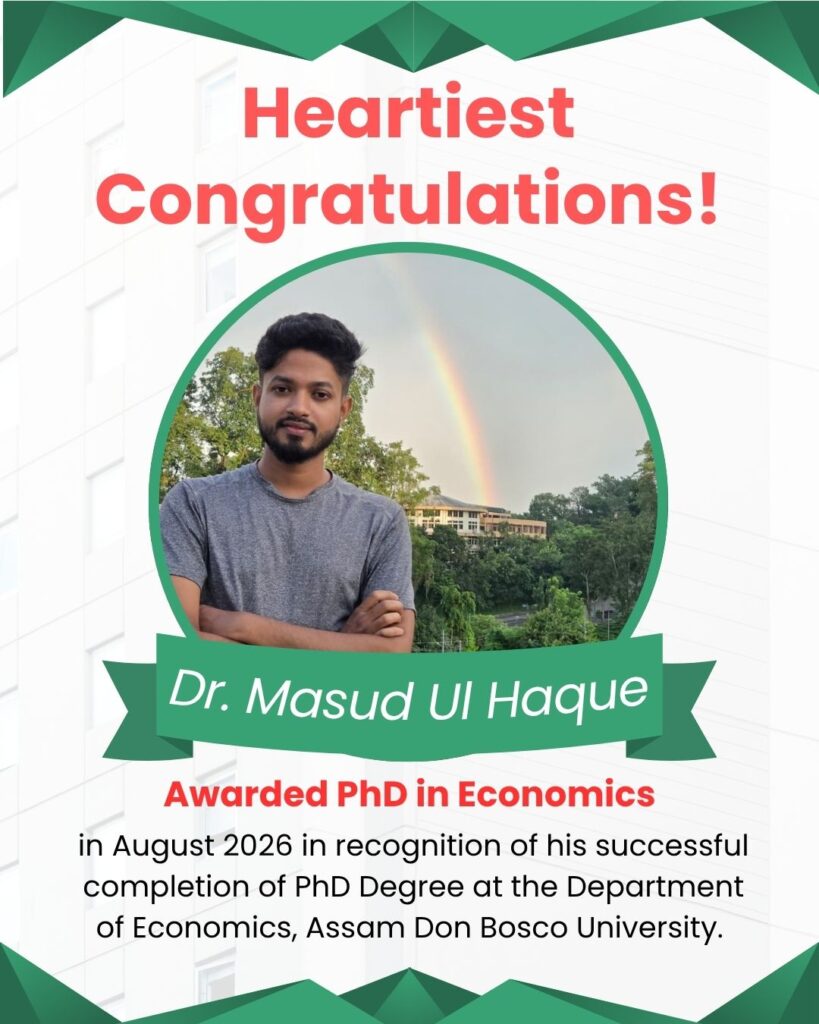
The Department of Economics proudly congratulates Dr. Masud Ul Haque for successfully defending his PhD thesis titled “A Comparative Study on Poverty and Policy Effectiveness between Char and Plain Areas in Assam” on 9th July 2026. The Department appreciates the valuable contribution made by Dr. Masud Ul Haque to the field of Poverty and Policy Effectiveness and wishes him continued success in future academic and professional endeavours. This significant academic achievement reflects his years of hard work, rigorous research, and scholarly dedication. Dr. Masud Ul Haque was a research scholar in the Department and worked under the supervision of Dr. Abdur Rashid Ahmed, Assistant Professor, Department of Economics, Assam Don Bosco University.
His doctoral thesis offers a comparative, empirically grounded examination of socio-economic conditions, the magnitude of poverty, the effectiveness of selected government schemes and women’s economic participation in char (river-island) and plain areas of Assam. Using a primary sample of 450 households in 2024 across four char-dominated districts and with secondary sources, the study applies monetary and poverty measures, constructs a Policy Effectiveness Index (PEI) for five major schemes, develops an Empowerment Assessment Index (EAI) for women, and employs econometric modelling (logit) to identify determinants of women’s workforce participation. Results show that char households face deeper multidimensional deprivation and greater service exclusion despite heterogeneity in income measures (where remittances and productive plots sometimes raise mean incomes). Implementation bottlenecks such as accessibility, payment delays, low financial literacy and tenure insecurity lead to reduce the realising potential of schemes such as MGNREGA, PMAY-G and PMJDY in char geographies. Women’s empowerment scores are lower in chars and regression analysis highlights marital status and religion as significant predictors of women’s economic participation. The thesis advocates for geography-sensitive policy design, financing the department targeted at Char area development, improved targeting and delivery mechanisms, and gender-focused interventions to translate scheme presence into meaningful poverty reduction and empowerment in Char contexts.