 contact@dbuniversity.ac.in
  09476 690 950/ 08011 403 982
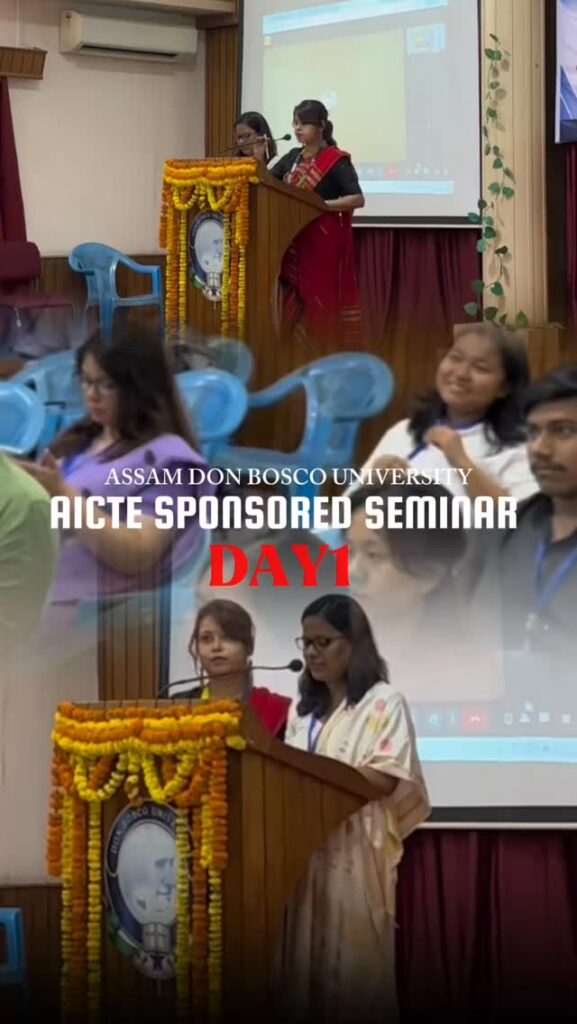
Blue Economy in Northeast India: Unlocking the Potential of Rivers and Waterways”
Organized by: Assam Don Bosco University, Azara, Guwahati
Sponsored by: AICTE under VAANI Scheme
Dates: 8th – 9th August 2025
Coordinator: Dr. Chayanika Das
Co-Coordinator: Dr. Suman Mahanta Bordoloi
Overview
Assam Don Bosco University successfully organized a two-day National Seminar under the AICTE VAANI Scheme with the dual objective of promoting the Bodo language and exploring the Blue Economy potential in Northeast India. The seminar brought together academicians, industry experts, and participants from across Assam to deliberate on sustainable development through rivers and waterways.
Inaugural Session
The seminar commenced with an inaugural ceremony attended by around 69 participants. The event began with an invocation, followed by the felicitation of distinguished guests and speakers. The ceremony set a collaborative and academic tone for the sessions ahead.
Key Sessions & Highlights
1. Blue Economy & Sustainable Development
Prof. Ayekpam Ibemcha Chanu highlighted the importance of sustainable utilization of water resources and linked the concept of the Blue Economy with the UN Sustainable Development Goals (SDGs). Emphasis was placed on balancing economic growth with environmental conservation and addressing regional challenges like unemployment and inequality.
2. Inland Waterways & Regional Growth
Discussions focused on the role of inland waterways in enhancing connectivity, trade, and employment. The session emphasized infrastructure development, entrepreneurship, and policy support as key drivers of regional economic development.
3. Eco-Tourism & Resource Management
Dr. Pankaj Baro elaborated on eco-tourism as a sustainable growth strategy. The session highlighted community participation, biodiversity conservation, and equitable distribution of tourism benefits across Northeast India.
4. Inland Water Transport (IWT) Potential
Mr. P. Bora (IWAI) discussed the strategic importance of waterways like the Brahmaputra and Barak rivers. Government initiatives such as infrastructure development and the Jalvahak Scheme were highlighted as catalysts for boosting trade and reducing transportation costs.
5. Fisheries & Entrepreneurship
Dr. Kamaleswar Boro emphasized the role of fisheries in livelihood generation and entrepreneurship. The session focused on modern aquaculture techniques, skill development, and bridging the employability gap.
6. Ornamental Aquascaping
Mr. Krishnendu Chowdhury introduced aquascaping as a creative and sustainable economic activity linked to biodiversity, eco-tourism, and small-scale entrepreneurship.
Key Outcomes
- Enhanced awareness of the Blue Economy concept in the Northeast context
- Recognition of inland waterways as a cost-effective and sustainable transport system
- Identification of opportunities in eco-tourism, fisheries, and entrepreneurship
- Emphasis on skill development and industry-academia collaboration
- Promotion of Bodo language through academic discourse
Conclusion
The seminar successfully provided a multidisciplinary platform to explore the vast potential of rivers and aquatic resources in Northeast India. It highlighted the need for sustainable practices, policy support, and community participation to unlock economic opportunities while preserving ecological balance.